
A DWI charge in New York isn’t a final judgment; it’s the opening move in a high-stakes legal battle where the state has already shown its hand. If you’re staring down the barrel of a prosecution, you’re likely feeling the crushing weight of a system designed to make you feel small. The anxiety over a permanent criminal record or the sudden loss of your livelihood is a heavy burden to carry alone. You feel powerless against the police, but you aren’t.
The evidence against you isn’t as insurmountable as the state wants you to believe. While the first offense DWI NY penalties include fines up to $1,000, mandatory surcharges of nearly $400, and an automatic six-month license revocation, these consequences aren’t set in stone. We’ll provide you with the strategic framework used to deconstruct these charges and find the mechanical flaws in the prosecution’s logic. This guide details exactly how to challenge the state’s narrative, preserve your driving privileges, and move from a place of vulnerability to one of tactical empowerment.
Key Takeaways
- Learn the critical distinction between a DWI and a DWAI, and how this difference determines whether you walk away with a permanent criminal record.
- Gain a clear understanding of the first offense DWI NY penalties, including license revocation and the long-term financial impact of the Driver Responsibility Assessment.
- Discover tactical methods for deconstructing breathalyzer results by identifying mechanical failures and gaps in equipment maintenance records.
- Master the “Silence is Shield” rule to prevent self-incrimination and learn which specific details of the initial stop are most vulnerable to legal challenge.
- Understand the high stakes for professional licenses and how a seasoned defender acts as a shield to protect your career and reputation from the state’s reach.
The High Stakes of a First-Offense DWI in NY: Understanding the Penalties
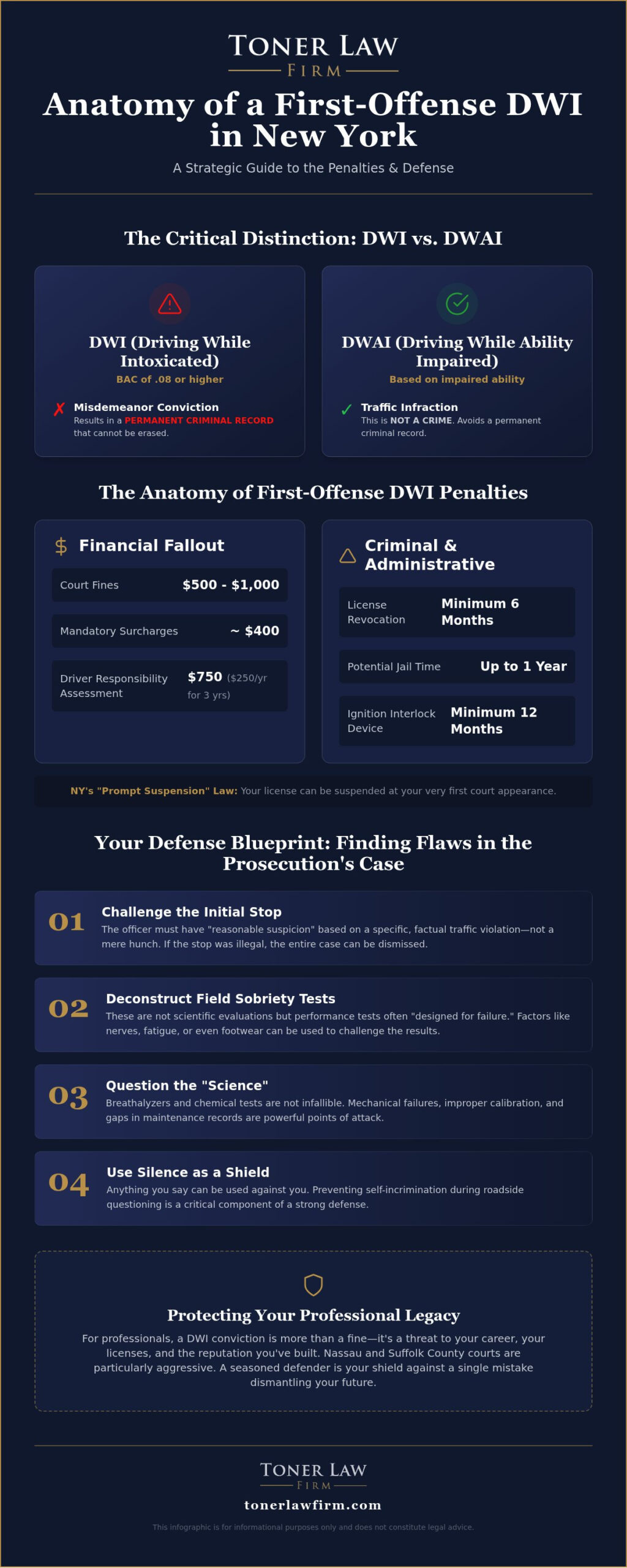
If you’re standing in a New York courtroom for the first time, you aren’t just facing a judge; you’re facing a machine designed to strip away your rights and your reputation. The state doesn’t see your clean record or your professional achievements; it only sees a BAC reading and a statute. Understanding the first offense DWI NY penalties is the first step in deconstructing the case against you. A standard DWI, involving a BAC of .08 or higher, is a misdemeanor. This means a conviction results in a permanent criminal record that can’t be erased. In contrast, a Driving While Ability Impaired (DWAI) charge is a traffic infraction. This distinction is the primary battleground for your future.
The financial fallout is engineered to be crushing. Beyond the initial fine of $500 to $1,000, you’ll face mandatory court surcharges of approximately $400. Then comes the Driver Responsibility Assessment (DRA), a civil penalty that costs you $250 per year for three years. If you don’t pay, you don’t drive. These costs, coupled with the threat of up to one year in jail, are meant to force you into a quick plea. Don’t take the bait. When evaluating the first offense DWI NY penalties, you must look beyond the courtroom and consider the long-term impact on your career. The Drunk driving laws in the United States vary by state, but New York’s “Prompt Suspension” law is particularly aggressive, often resulting in an immediate license suspension at your very first court appearance.
Criminal vs. Administrative Consequences
Your battle is fought on two separate fronts: the criminal court and the DMV. Winning in one doesn’t guarantee victory in the other. Even if we secure a dismissal in court, the DMV may still move to revoke your privileges through administrative hearings. Additionally, New York requires an Ignition Interlock Device (IID) for all DWI convictions, even for first-time offenders. This mechanical “tether” must be installed in every vehicle you own or operate for at least 12 months, adding another layer of expense and public stigma to your daily life. The system is designed to make you feel powerless, but every administrative hurdle has a counter-move.
Special Considerations for Nassau and Suffolk Drivers
If you’re a professional in Garden City or commute through Long Island, the stakes are even higher. Nassau and Suffolk County prosecutors are notoriously rigid compared to those in New York City. A conviction here doesn’t just mean a fine; it means a total disruption of your ability to reach your office or transport your family. Navigating the Nassau County DUI Penalties: Navigating the Legal Gauntlet in 2026 requires a defender who understands the local nuances of these specific courts. We act as your shield, ensuring that a single mistake doesn’t dismantle the professional legacy you’ve spent decades building.
Deconstructing the Arrest: Finding Flaws in the Prosecution’s Evidence
If you’ve been arrested, the prosecution wants you to believe their evidence is a solid wall. It isn’t. It’s a series of subjective guesses and mechanical checklists that are often riddled with human error. To avoid the harshest New York DWI penalties, we must attack the very moment the officer’s lights flashed in your rearview mirror. The state’s case is only as strong as its foundation, and that foundation usually begins with the “initial stop.”
Did the officer actually see a traffic violation? If the “reasonable suspicion” for the stop was based on a hunch rather than a specific, articulable fact, the entire case might be eligible for dismissal. We look for procedural errors that the state tries to gloss over. Standardized Field Sobriety Tests (SFSTs), such as the Walk-and-Turn and One-Leg Stand, aren’t scientific medical evaluations. They’re performance tests designed for failure. If you’re nervous, tired, or wearing restrictive footwear, you’re set up to “fail” even if you’re stone-cold sober. We use dashboard and body camera footage to show a different story than the one written in the police report.
Challenging the Probable Cause for Arrest
If the initial stop was illegal, we can dismantle the prosecution’s case through a suppression hearing. This is where we hold the state accountable for the officer’s shortcuts. During roadside interrogations, officers often push for self-incriminating statements before they’ve even established a legal reason for the arrest. We also analyze external factors like uneven road surfaces, wind, or poor lighting that make field sobriety tests inherently unfair. When these variables are present, the results are legally compromised. You need a trial-ready strategy to expose these contradictions before they lead to a conviction.
The ‘Inherent Unreliability’ of Human Observation
Nassau County police often mistake simple fatigue or seasonal allergies for signs of intoxication. When a report mentions “bloodshot eyes” or “slurred speech,” it’s often just scripted language used to justify an arrest that was already decided. A seasoned defender looks for “boilerplate” descriptions by comparing the officer’s written report against the actual video evidence. If the officer’s narrative describes a stumbling driver but the video shows someone standing perfectly still, the prosecution’s credibility crumbles. These contradictions are the keys to deconstructing the first offense DWI NY penalties and protecting your future. We don’t just accept the officer’s word; we tear it apart under the lens of physical reality.
Challenging the Science: Flaws in Breathalyzer and Blood Evidence
If the prosecution rests its case on a digital readout, they’re banking on your belief that the machine is infallible. It isn’t. A breathalyzer is not a medical grade diagnostic tool; it’s a field instrument with a documented margin of error that can be the difference between a conviction and a dismissal. While the first-offense DWI penalties in New York are severe, they’re often built on a foundation of shaky science. We don’t just accept a .08 reading as fact. We treat it as a mechanical estimate that is subject to environmental, biological, and procedural interference.
The state’s case often collapses when we demand the calibration and maintenance records for the specific device used in your arrest. These machines require meticulous upkeep; if the “solution” used to calibrate the device was expired or the logs show a history of mechanical failure, the integrity of your result is compromised. Furthermore, New York law requires a strict 20 minute “observation period” before a breath test. If the officer was distracted, filling out paperwork, or failed to ensure you didn’t burp or vomit during that window, the test result may be legally voided. Even your own body can work against the machine. Conditions like Gastroesophageal Reflux Disease (GERD), recent dental work, or even a strict low carb diet can trap “mouth alcohol” or ketones that the device misinterprets as deep lung air, artificially inflating your BAC.
Operator Error and Certification Issues
The machine is only as reliable as the person operating it. We investigate whether the officer was properly certified to use that specific model on the date of your arrest. If they failed to follow the manufacturer’s strict testing protocols, the results shouldn’t be used against you. This tactical scrutiny is especially vital if you refused a breathalyzer test in NY, as the state will try to use that refusal as “consciousness of guilt.” We act as your shield, ensuring that technicalities and human error aren’t used to dismantle your future.
Rising Blood Alcohol Defense
Alcohol absorption is a biological process, not an instant event. You might have been perfectly legal while driving, only for your BAC to peak an hour later at the police station. This is the “Rising Blood Alcohol” defense. We use retrograde extrapolation, which is the mathematical process of calculating your BAC at the time of driving based on later test results, to prove you were under the limit when it actually mattered. If the timing of your last drink aligns with this biological curve, we can deconstruct the prosecution’s narrative and protect you from the first offense DWI NY penalties that threaten your livelihood.
A Tactical Blueprint: How to Beat a DWI in NY Step-by-Step
If you’ve recently been processed and released, the state already has a head start on building its case. You must pivot immediately from a state of shock to one of tactical preparation. While the first offense DWI NY penalties loom large, your defense begins the moment you leave the station. Document every detail while the memory is fresh: the weather, the officer’s exact words, and the physical environment of the stop. This documentation serves as the raw material for deconstructing the prosecution’s narrative later in the process.
Your greatest asset during this crisis is the “Silence is Shield” rule. Every word you speak to the police without an advocate is a potential weapon they’ll use to justify the harshest first offense DWI NY penalties. Simultaneously, we must secure private evidence that the police often ignore. If you were at a restaurant or a professional event before the stop, we need that private surveillance footage and those witness statements before they’re deleted or forgotten. A sober demeanor captured on a private security camera can dismantle an officer’s subjective claim of “impairment” or “unsteady gait.” An early independent evaluation by a defense expert can also identify biological factors that the state’s machines are programmed to ignore.
Phase 1: The First 48 Hours
If you refused the chemical test, the clock is already running. You have only 15 days to request a DMV Refusal Hearing; missing this window results in an automatic one year license revocation, regardless of what happens in criminal court. This is also the critical time to document any medical conditions, such as a back injury or vision issues, that likely affected your performance on field sobriety tests. You need a DWI Lawyer Long Island: Tactical Defense for Nassau & Suffolk Charges (2026) to initiate these protections and secure your right to drive before the state’s administrative machinery locks you out.
Phase 2: Discovery and Pre-Trial Motions
The “Motion to Suppress” is our most aggressive tool in dismantling the prosecution’s case. If we can prove the initial stop lacked reasonable suspicion, the entire case can be dismissed before it ever reaches a jury. We use New York’s “CPL 245” discovery rules to force the prosecution to hand over every piece of evidence, including the hidden maintenance logs of the breathalyzer. If the machine’s calibration records show a pattern of mechanical instability, that evidence becomes a liability for the state. We don’t wait for the trial to find the cracks in their strategy; we win by deconstructing the case during the pre-trial phase. Don’t let the prosecution dictate your future. Contact a seasoned defender to begin your counter-offensive today.
Why Your Professional Legacy Demands a Seasoned Defender
If you’ve spent decades building a professional reputation, a single arrest can feel like an explosive charge set at the foundation of your legacy. The state views you as a statistic, but for a physician, executive, or commercial pilot, the first offense DWI NY penalties represent a direct threat to your livelihood. A conviction creates a permanent criminal record that triggers mandatory reporting requirements to licensing boards and human resources departments. You aren’t just fighting a traffic ticket; you’re running a professional gauntlet where the stakes are your career and your future stability. When you begin searching for DWI lawyers near me, it’s critical to evaluate whether a prospective defender has a documented history of dismantling the specific evidence tactics used by Nassau and Suffolk County prosecutors.
Prosecutors in Nassau and Suffolk County are often less interested in justice than they are in maintaining a high conviction rate. They expect you to be intimidated by the resources of the state and to accept a plea deal that includes a criminal record. However, the dynamic changes when you walk into court with a trial-ready defender. We’ve seen that prosecutors offer significantly better reductions to advocates who have a documented history of taking cases to a jury. When the state knows their evidence will be deconstructed and their witnesses cross-examined by an expert, their confidence in those first offense DWI NY penalties begins to erode. We turn their certainty into a liability.
Protecting Your Career and Future
A DWI conviction is a red flag that never stops waving during background checks for executive positions or security clearances. For medical professionals and financial advisors, the fallout extends to disciplinary hearings that can result in the suspension or loss of a license. We tailor our defense strategies specifically for high-stakes professionals, focusing on outcomes that preserve your ability to practice and lead. Our goal is to ensure your DWI Defense for Professionals in NY: Protecting Your License, Career, and Legacy is as robust as the work you’ve put into your career. We protect your future by dismantling the state’s past assertions.
The Toner Law Firm Shield
James Toner brings 30+ years of street-smart wisdom to every case, having spent decades navigating the specific nuances of Nassau and Suffolk courts. We don’t just review the prosecution’s file; we hunt for the hidden cracks in their narrative that a less experienced advocate would miss. This methodical approach moves you from a place of fear to a place of empowerment. Taking the first step by requesting a consultation is how you reclaim control of your narrative and begin the process of recovery. We stand as your shield against the state, protecting the professional legacy you’ve worked too hard to lose.
Reclaim Your Future and Defeat the Charge
If you’re facing a prosecution, don’t let the weight of the state’s machinery crush your resolve. We’ve deconstructed the mechanical flaws in breathalyzers and the subjective nature of police reports to demonstrate that a charge is merely an opening move, not a final judgment. While the first offense DWI NY penalties are designed to be life-altering, they aren’t inevitable for those who choose to fight back with a tactical blueprint. You’ve spent years building a professional legacy; it doesn’t have to be dismantled by a single night’s events or a scripted police narrative. Every piece of evidence has a potential crack.
You need a vigilant guardian who understands the specific nuances of Nassau and Suffolk County courts. With 30+ years of Long Island trial experience, James Toner focuses on the aggressive deconstruction of police evidence to protect your reputation and your livelihood. This is the moment to move from a place of vulnerability to one of hard-earned confidence. Take the first step toward recovery and empowerment by securing an advocate who isn’t afraid to challenge the system. Secure Your Shield: Contact Toner Law Firm for a Strategic DWI Consultation. Your future is worth the fight.
Frequently Asked Questions
Can I get my DWI charges dismissed if it’s my first offense in NY?
DWI charges can be dismissed if we successfully challenge the legality of the initial traffic stop or the reliability of the breathalyzer evidence. If the officer lacked reasonable suspicion to pull you over, any evidence gathered afterward is often suppressed. While the prosecution rarely drops charges voluntarily, a tactical deconstruction of their case can force a dismissal or a reduction to a non-criminal infraction.
What is the difference between DWI and DWAI in New York?
A DWI is a misdemeanor criminal offense triggered by a BAC of .08 percent or higher. In contrast, a Driving While Ability Impaired (DWAI) is a traffic infraction for BAC levels between .05 and .07 percent. This distinction is critical because a DWI results in a permanent criminal record, while a DWAI does not. The first offense DWI NY penalties are significantly more severe than those for a DWAI infraction.
Will I go to jail for a first-offense DWI on Long Island?
Jail time is a legal possibility for a first-offense DWI, with a maximum sentence of one year in a county facility. While first-time offenders without accidents or aggravating factors are less likely to serve time, Nassau and Suffolk County judges maintain the discretion to impose it. Your defense strategy focuses on highlighting your professional standing and clean record to mitigate the risk of incarceration.
How long will my driver’s license be suspended after a DWI arrest?
For a standard first-offense DWI conviction, your license will be revoked for a minimum of six months. If you’re convicted of the lesser DWAI infraction, the suspension period is typically 90 days. These timeframes don’t include the “Prompt Suspension” that often occurs at your first court date. Regaining your full privileges requires completing specific DMV requirements and paying all associated civil penalties.
Can a lawyer help me get a hardship license or conditional license?
A lawyer can often help you secure a conditional license that allows you to drive to work, school, or medical appointments. You must typically wait until your case has reached a certain stage or until you’ve enrolled in the Impaired Driver Program (IDP). A hardship license is a separate, more restrictive permit that may be granted shortly after your arrest to prevent extreme financial or personal loss.
What happens if I refused the breathalyzer test in New York?
Refusing a chemical test triggers an automatic one-year license revocation under New York’s Implied Consent Law. This administrative penalty is separate from your criminal case and takes effect even if you’re found not guilty of the DWI. You have only 15 days from your arraignment to request a Refusal Hearing to challenge this revocation. Refusal also results in a $500 civil penalty.
How much does a DWI defense lawyer cost in Nassau County?
The cost of a DWI defense in Nassau County varies based on the complexity of the evidence and whether the case proceeds to a full trial. Legal fees reflect the intensity of the work required to deconstruct police reports and challenge chemical test results. While we don’t provide flat rates, a consultation allows us to evaluate your specific situation and provide a transparent overview of the defense process.
Is a first-offense DWI considered a felony or a misdemeanor in NY?
A standard first-offense DWI is classified as a misdemeanor in New York State. However, if there was a child under 16 in the vehicle, the charge is elevated to a felony under Leandra’s Law. Understanding the first offense DWI NY penalties requires recognizing that even a misdemeanor conviction creates a permanent criminal record. This record can interfere with professional licensing and future employment opportunities if not aggressively defended.