


If you believe a Nassau County arrest is simply a legal hurdle to clear, you haven’t felt the full weight of the machinery designed to dismantle your life. The state doesn’t just want a conviction; it wants your license, your reputation, and your freedom. You’re likely paralyzed by the fear of jail time or the realization that your career is hanging by a thread. It’s a heavy burden to carry. You already know the DUI penalties Nassau County prosecutors seek are meant to be life-altering, and the system isn’t interested in your side of the story.
This guide provides the clarity you need to survive this systemic assault. You’ll learn how a tactical defense can act as a shield, protecting your livelihood and keeping your record clean. We will break down the dual-front battle between the DMV and the Criminal Court, exposing the vulnerabilities in the prosecution’s evidence that a seasoned defender can deconstruct. The path from vulnerability to empowerment starts with knowing exactly how to fight back.
Key Takeaways
- Identify the critical legal distinctions between DWI and DWAI under VTL 1192 to prepare for the aggressive prosecution tactics used by the Nassau County District Attorney.
- Grasp the full scope of DUI penalties Nassau County imposes, from immediate financial surcharges to the looming threat of incarceration and a permanent criminal record.
- Prepare for the collateral damage of Leandra’s Law by understanding the mandatory requirements for ignition interlock devices and their impact on your professional reputation.
- Secure your right to drive by navigating the DMV’s complex administrative process, including the strict 15-day deadline for challenging a chemical test refusal.
- Discover how a tactical defense deconstructs the prosecution’s case by attacking the validity of the initial traffic stop and the scientific calibration of breathalyzer equipment.
The Nassau County DUI Landscape: A High-Stakes Environment
If you find yourself facing an arrest in Garden City or Mineola, you aren’t just dealing with a traffic ticket. You’ve entered a system designed to process you with clinical efficiency. The Nassau County District Attorney’s Office has built a reputation for being one of the most aggressive in New York, and by 2026, the “zero-tolerance” culture on Long Island has only intensified. Every arrest on the Meadowbrook or Northern State Parkway funnels into the First District Court in Hempstead, where the machinery of the state is geared toward conviction. Understanding the DUI penalties Nassau County enforces starts with recognizing that the prosecution isn’t looking for excuses; they’re looking for results.
VTL 1192 Classifications: Knowing the Charges
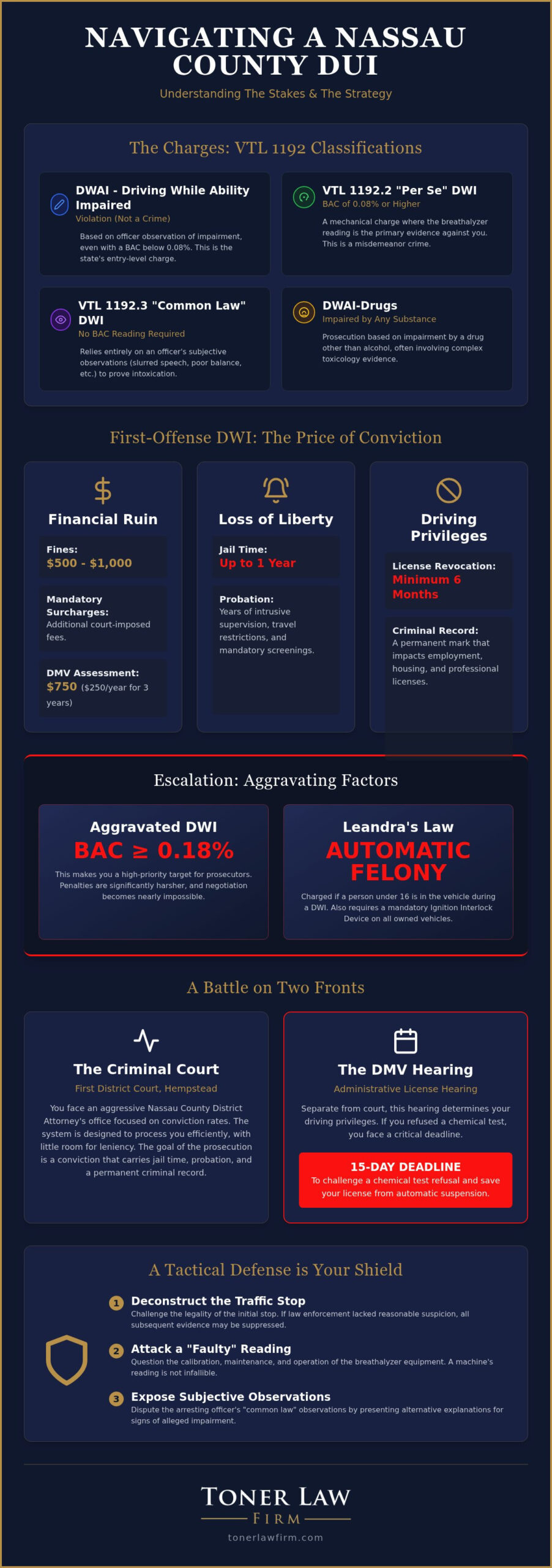
The legal framework used to pin you down is New York Vehicle and Traffic Law (VTL) 1192. Most drivers are familiar with the 0.08% Blood Alcohol Content (BAC) threshold, which triggers a VTL 1192.2 “Per Se” DWI charge. This is a mechanical prosecution where the machine’s reading is the primary evidence. However, the state often doubles down with VTL 1192.3, known as “Common Law” DWI. This charge relies entirely on an officer’s subjective observations, such as slurred speech or poor balance, meaning you can be charged even without a chemical test result. The stakes escalate further with DWAI-Drugs or cases involving Leandra’s Law, which turns a standard offense into a felony if a minor is in the vehicle. These classifications aren’t just labels; they are the blueprints the state uses to dismantle your future.
Why Nassau County Enforcement is Unique
Enforcement here is a coordinated assault. Local police departments (NCPD) work in lockstep with the District Attorney to maximize the impact of every stop. The DUI penalties Nassau County delivers are often harsher than those in neighboring jurisdictions because of this institutional coordination. Sobriety checkpoints on major parkways aren’t just for safety; they’re data-gathering operations meant to feed the system. If you’re stopped, the officer’s goal is to build a narrative of impairment before you even say a word. The “Nassau County Gauntlet” is the combined pressure of an unyielding prosecution and the administrative hurdles that begin the moment you are processed. This environment requires more than just a standard defense. It demands a tactical deconstruction of how the evidence was gathered and how the law is being applied against you. You’re fighting a battle on two fronts, and the court in Hempstead is where the first blow is struck.
If you believe the judge will show leniency because it’s your first offense, you are miscalculating the system’s intent. The DUI penalties Nassau County courts impose are designed to be punitive and life-altering. The state doesn’t view you as an individual with a career and a family; it views you as a data point in a conviction quota. From the moment the gavel falls, you face a coordinated assault on your bank account, your reputation, and your physical freedom. It is a high-stakes environment where the prosecution holds all the initial leverage.
Fines are only the beginning of the financial fallout. While the base fine for a first-time DWI typically ranges between $500 and $1,000, the “hidden” costs are where the real damage occurs. You’ll be hit with mandatory court surcharges and the DMV Driver Responsibility Assessment. This assessment alone drains $250 from your pocket every year for three years. If you fail to pay, your license is suspended indefinitely. It’s a mechanical trap designed to keep you entangled in the legal system long after your court date has passed.
First-Offense DWI Consequences
A misdemeanor DWI conviction carries a maximum jail sentence of one year. While many first-time offenders hope to avoid a cell, the alternative is often years of intrusive probation. Probation isn’t a slap on the wrist. It involves strict travel restrictions, mandatory drug and alcohol screenings, and a probation officer who has the power to upend your daily routine at a moment’s notice. Additionally, your license will be revoked for a minimum of six months, effectively grounding your life and making even the simplest commute a legal risk.
Escalation: Aggravated DWI and Felony Charges
The landscape turns significantly more hostile if your Blood Alcohol Content (BAC) reaches 0.18% or higher. This triggers an Aggravated DWI charge, a classification that signals to the Nassau County District Attorney that you are a high-priority target. The DUI penalties Nassau County prosecutors seek for these elevated charges are often non-negotiable. If you have a prior conviction within the last decade, the state upgrades the charge to a felony. An E-Felony or D-Felony conviction carries the threat of years in state prison and the permanent loss of civil rights.
In New York, a DWI conviction is a permanent scar on your record. There is no expungement process to “clean up” your history later. Every background check for the rest of your life will reveal this conviction, potentially closing doors to employment and housing. If you are ready to challenge the prosecution’s narrative and protect your future, it’s time to examine the tactical defense strategies that can shield your reputation from this systemic assault.
The Collateral Damage: Leandra’s Law and Professional Ruin
If you think the court’s sentence is the end of your ordeal, you’re overlooking the administrative machinery designed to monitor your every move. The DUI penalties Nassau County enforces extend far beyond the courtroom walls. While the judge handles your freedom, the state uses Leandra’s Law to reach into your personal life and your wallet. This isn’t just about a one-time fine; it’s about a sustained, mechanical assault on your autonomy. You are forced to pay for the privilege of being monitored, turning your own vehicle into a mobile reminder of your legal crisis.
The financial burden of these collateral consequences often outweighs the initial court fines. Beyond the installation fees, you’ll face monthly monitoring costs and calibration charges that add up to thousands of dollars over the course of a year. Your auto insurance provider will likely view you as a high-risk liability, leading to premium spikes that can last for years or the total cancellation of your policy. This is the “scarlet letter” effect in action, where the system ensures your conviction remains a visible part of your life long after you’ve completed your community service or probation.
Navigating the Ignition Interlock Requirement
The Ignition Interlock Device (IID) is a breathalyzer wired into your car’s ignition system. It requires a clean breath sample to start the engine and periodic “rolling retests” while you are driving. Under Leandra’s Law, even a first-offense misdemeanor DWI conviction triggers the mandatory installation of an Ignition Interlock Device on any vehicle you own or operate. In Nassau County, this requirement typically lasts for 12 months. Any failed test or missed retest triggers a “lockout” violation, which is immediately reported to the court or your probation officer, potentially leading to a violation of probation and additional jail time.
Career Vulnerability for Professionals
For many, the greatest threat isn’t the device in their car, but the damage to their professional standing. If you hold a professional license, the state boards for nursing (OPD) or education (OESE) have strict reporting requirements that can lead to disciplinary hearings or the revocation of your credentials. Licensed professionals face a unique vulnerability:
- CDL Holders: A single DWI conviction can lead to a lifetime ban from commercial driving, effectively ending a career.
- Security Clearances: Federal employees or contractors in Garden City often find their security clearances revoked, making them unemployable in their chosen field.
- Corporate Bonding: Many executive positions require the ability to be bonded, a status that is often lost following a criminal conviction.
Our defense strategy focuses on protecting your professional reputation by deconstructing the prosecution’s evidence before it reaches these licensing boards. We act as a shield, ensuring that a single mistake doesn’t result in the total dismantling of the career you’ve spent decades building. Doctors, attorneys, and other credentialed individuals facing these risks should explore the specialized strategies outlined in our guide to DWI defense for professionals in NY, which addresses the unique intersection of criminal law and professional licensing.
If you assume your driver’s license is safe until a conviction occurs, you’re unprepared for the administrative ambush waiting at your first court appearance. The DUI penalties Nassau County prosecutors leverage include the “Prompt Suspension Law,” a mechanical rule that strips you of your driving privileges before you’ve even had a chance to argue your case. If the police have a certified chemical test result showing a BAC of 0.08% or higher, the judge at the First District Court in Hempstead is legally required to suspend your license at your arraignment. This immediate loss of mobility is designed to pressure you into a position of weakness before the legal battle truly begins.
Surviving this initial strike requires an immediate request for a hardship hearing. This is a narrow, high-stakes proceeding where you must prove that losing your license creates an “extreme hardship” that prevents you from earning a living or receiving medical care. The criteria are incredibly strict. You cannot simply claim it’s inconvenient to take the bus; you must demonstrate that no other reasonable transportation exists. Even then, a hardship license only permits travel to and from work or medical appointments during specific hours. It’s a tether, not a restoration of freedom.
The Refusal Hearing: A Critical Tactical Junction
If you refused a chemical test, you face a separate administrative gauntlet at the DMV. You have a strict 15-day window from the date of your arraignment to schedule a Refusal Hearing. This hearing is entirely independent of your criminal case. Even if your criminal charges are dismissed, the DMV can still revoke your license for one year and hit you with a $500 civil penalty. The burden of proof at this hearing is lower than in criminal court, requiring only a “preponderance of evidence” rather than proof beyond a reasonable doubt. However, this hearing is also a tactical opportunity. It’s often the first time your defense can cross-examine the arresting officer under oath, allowing us to find the cracks in their narrative and deconstruct their probable cause for the initial stop. Understanding how a refused breathalyzer test lawyer in NY can turn the state’s rigid procedural rules against them is critical to protecting your driving privileges at this stage.
Restoring Your Right to Drive
Reclaiming your life requires navigating the Impaired Driver Program (IDP). Completing this program is usually a prerequisite for license restoration, but it’s fraught with bureaucratic traps. For repeat offenders, the DMV may trigger a “Permanent Revocation” based on your lifetime driving record, a devastating blow that can ground you for years regardless of the court’s sentence. We coordinate your DMV and Court strategies to ensure that every move in Hempstead supports your standing in Albany. If you’re ready to fight for your mobility, contact Toner Law Firm today to begin deconstructing the state’s case against your license.
Dismantling the Prosecution: The Toner Law Firm Strategy
The weight of the system is designed to make you feel defeated before you even step into the courtroom. When you’re staring down the DUI penalties Nassau County prosecutors demand, it’s easy to believe that the state’s evidence is an impenetrable wall. It isn’t. The prosecution relies on a chain of events that must be flawless to secure a conviction. If a single link in that chain is weak, the entire case can be pulled apart. We don’t look for mercy from the court; we look for the cracks in the state’s narrative that allow us to deconstruct their logic with clinical precision.
Our strategy begins with a surgical analysis of the initial stop. If the officer lacked probable cause to pull you over, every piece of evidence gathered afterward, from the smell of alcohol to the breathalyzer result, becomes inadmissible. We scrutinize the officer’s stated reasons, comparing them against GPS data and dash-cam footage. In many cases, the “suspicious driving” described in a police report doesn’t hold up under professional scrutiny. When the foundation of the arrest is flawed, the prosecution’s house of cards falls.
We also challenge the mechanical reliability of the state’s equipment. A breathalyzer isn’t a magic box; it’s a sensitive instrument that requires precise calibration and strict adherence to protocol. If the machine wasn’t maintained according to New York standards, or if the officer failed to observe the mandatory waiting period, the results are compromised. Similarly, Standardized Field Sobriety Tests (SFSTs) are notoriously subjective. Factors like road conditions, footwear, or underlying physical health can cause a sober person to “fail” a test. We expose these variables to show that a failure on paper doesn’t equal guilt in reality.
A Tactical Approach to Evidence
Navigating a high-stakes legal crisis requires more than just academic knowledge. It demands the real-world grit that comes from 30+ years of trial experience in Nassau County. We treat the courtroom like a battlefield, utilizing body-cam footage and precinct records to identify procedural violations that less experienced advocates might miss. This tactical evidence analysis allows us to negotiate from a position of strength. When the District Attorney knows we are trial-ready and capable of dismantling their witnesses, the path toward reduced charges or dismissals becomes much clearer.
Securing Your Future
You should never plead guilty at your arraignment without a comprehensive tactical review of your case. Doing so is a surrender to a system that isn’t interested in your side of the story. Your reputation, your career, and your freedom are too valuable to leave to chance. By moving from a place of vulnerability to a place of empowerment, you take control of the narrative. We stand as your shield, protecting you from the full impact of DUI penalties Nassau County seeks to impose. Protect your rights and your future-contact Toner Law Firm today.
Securing Your Future Against the Nassau Gauntlet
The machine of the state is designed to process you with cold efficiency, but it isn’t infallible. The combined pressure of administrative license suspensions and the criminal court system creates a high-stakes environment where your career and freedom are the primary targets. From the invasive requirements of Leandra’s Law to the immediate threat of the Prompt Suspension Law, the DUI penalties Nassau County prosecutors pursue are meant to leave a permanent mark on your life. You don’t have to face this systemic assault alone.
By deconstructing the prosecution’s science and identifying procedural cracks in the initial stop, you move from a place of vulnerability to one of empowerment. Our firm acts as a shield, leveraging decades of grit to protect the life you’ve built. Don’t let a single arrest define your entire future. There are always vulnerabilities in the state’s case if you know where to look.
Shield your future from Nassau County DUI penalties. Consult with James Toner. With 30+ years of trial experience and deep Garden City local expertise, we provide the aggressive criminal defense advocacy you need to win. You have the strength to challenge the system, and we have the tactical experience to lead the way.
Frequently Asked Questions
Is a DWI a felony in Nassau County?
A first-offense DWI is typically classified as a misdemeanor. However, the charge escalates to a felony if you have a prior conviction within the last 10 years or if a minor under 16 was in the vehicle at the time of the arrest. Felony convictions carry the threat of state prison and a permanent criminal record that cannot be erased.
Can I get a conditional license if I refused the breathalyzer?
No, you are generally ineligible for a conditional license if your suspension is based on a chemical test refusal. The DMV imposes a mandatory one-year revocation for refusals, which is an administrative penalty separate from your criminal court case. This rule is designed to be punitive, leaving you with very few options to regain your driving privileges during the revocation period. Working with a refused breathalyzer test lawyer in NY gives you the best chance of challenging the state’s procedural requirements and protecting your driving privileges at the DMV hearing.
What is the “Prompt Suspension Law” in New York?
The Prompt Suspension Law requires a judge to suspend your driver’s license at your very first court appearance if you had a BAC of 0.08% or higher. This suspension happens at your arraignment, often before you’ve had a chance to review the evidence against you. It is a mechanical application of the law that strips you of your mobility almost immediately after an arrest.
Will I go to jail for a first-offense DUI in Nassau County?
Jail is a legal possibility, though it isn’t always the standard outcome for a first-time offender. A misdemeanor conviction carries a maximum sentence of one year in jail, but the DUI penalties Nassau County prosecutors seek often focus on heavy fines and intrusive probation. Your risk of incarceration increases significantly if there were aggravating factors like a high BAC or an accident.
How much does a DWI conviction cost in total penalties?
The total cost of a conviction often reaches thousands of dollars once all hidden fees are calculated. Beyond the base court fines, you must pay mandatory surcharges, the $750 DMV Driver Responsibility Assessment, and the costs associated with an Ignition Interlock Device. When you factor in the inevitable insurance premium spikes, the DUI penalties Nassau County imposes become a long-term financial burden.
Can a Nassau County DWI be expunged or sealed?
No, New York does not have an expungement law that allows you to wipe a DWI conviction off your record. Once you are convicted, the record is permanent and will appear on background checks for employment and housing indefinitely. While some non-DWI offenses can be sealed after a decade, alcohol-related driving crimes are generally excluded from these protections, making your initial defense critical.
What happens if I am caught driving with a suspended license after a DUI?
You will face a charge of Aggravated Unlicensed Operation (AUO), which is a serious criminal offense. If your license was suspended due to a DWI, the state treats the violation as a defiance of court authority. This can lead to mandatory jail time, the seizure of your vehicle, and a permanent revocation of your right to drive in New York.
How long does the Ignition Interlock Device stay in my car?
The Ignition Interlock Device (IID) requirement typically lasts for 12 months for most Nassau County convictions. Under Leandra’s Law, the device is mandatory even for first-time offenders. While it is possible to petition the court for removal after six months, any recorded violations or “lockouts” will likely result in the court extending the requirement or triggering a violation of probation.