
You might think that saying “no” to a breathalyzer at the precinct has already sealed your fate, but in New York, a refusal is not a confession. It is a procedural battleground where the state’s own rigid rules can be turned against them to shield your rights. If you’re currently paralyzed by the fear of losing your driving privileges for a full year or the anxiety of a jury hearing about your “consciousness of guilt,” you’re not alone. The system is designed to make you feel like the fight is over before it even begins.
This guide breaks down the high-stakes consequences of your decision and the tactical maneuvers a seasoned refused breathalyzer test lawyer NY uses to protect your future. We will explore how to deconstruct the prosecution’s case without BAC data, navigate the critical DMV hearing, and fight to avoid those crushing $500 to $750 civil penalties that threaten your financial recovery. Whether it’s fighting for a conditional license or finding the hidden cracks in the arresting officer’s testimony, you’ll learn exactly how to move from a place of vulnerability to a position of strength. You don’t have to let the state’s machinery crush your reputation without a fight.
Key Takeaways
- Understand the critical difference between the roadside PBT and the precinct chemical test, and why New York’s Implied Consent Law makes the latter mandatory.
- Identify the full financial weight of a refusal, including the $500 civil penalty and the $750 Driver Responsibility Assessment spread over three years.
- Learn why you must act within a strict 15-day window to request a DMV refusal hearing, which operates independently from your criminal court case.
- Discover how a refused breathalyzer test lawyer NY can dismantle the state’s case by exposing flaws in the initial traffic stop or errors in the mandatory refusal warnings.
- Explore tactical strategies to protect your reputation in Nassau and Suffolk counties, even when the prosecution lacks BAC evidence.
The Reality of NY’s Implied Consent Law: Why the State Claims You Already Agreed
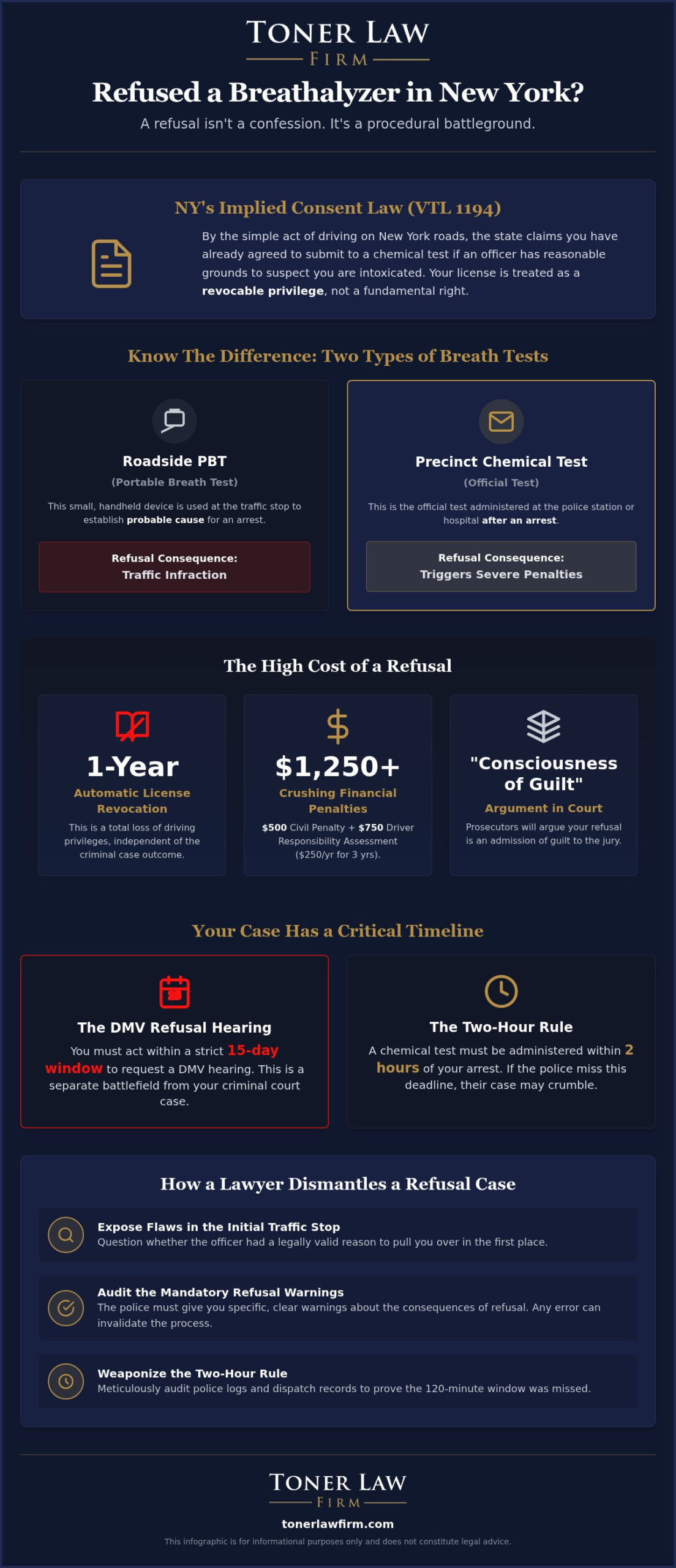
If you find yourself on the side of the road with flashing lights in your rearview mirror, you are already caught in a legal snare you likely didn’t know existed. New York Vehicle and Traffic Law Section 1194 (VTL 1194) operates on a premise that feels inherently unfair. By the simple act of driving on public roads, the state argues you have already agreed to submit to a chemical test if an officer has reasonable grounds to believe you’re intoxicated. This is known as NY’s Implied Consent Law. The state treats your license as a revocable privilege rather than a fundamental right. They use this doctrine as a mechanical lever, intended to force your compliance through the threat of immediate, severe administrative penalties. When you are standing on the pavement, the officer isn’t just asking for your cooperation; they are testing the limits of your knowledge. Finding a refused breathalyzer test lawyer NY is your first step in deconstructing this trap and reclaiming your standing.
The Difference Between Field Tests and Chemical Tests
Many drivers confuse the portable breath test (PBT) at the roadside with the official chemical test at the precinct. If you blow into the small handheld device and fail, the officer uses that data to establish probable cause for your arrest. However, refusing the PBT is a traffic infraction, not the high-stakes refusal that triggers a one-year license revocation. That “official” refusal only occurs when you are asked to submit to a chemical test at the police station or a hospital after you’ve been placed under arrest. The state wants you to believe every “no” carries the same weight. It doesn’t. A refused breathalyzer test lawyer NY knows how to separate these moments to show where the police may have overstepped their authority or failed to provide proper warnings.
The Two-Hour Rule: A Critical Timeline
Time is the prosecution’s greatest enemy and your most effective shield. Under New York law, a chemical test must be administered within two hours of your arrest to be considered valid evidence under the implied consent statutes. If the police wait 121 minutes to request the sample, the mechanical certainty of the state’s case begins to fracture. This 120-minute window is a hard boundary. We meticulously audit every police log and dispatch record to find these discrepancies. If the clock ran out before they secured a refusal, the entire foundation of their administrative penalty may crumble. Precise time-logging is not just a detail; it is a tactical weapon used to dismantle the state’s machinery and protect your future.
Immediate Consequences: License Revocation and Civil Penalties for Refusal
If you chose to refuse the chemical test at the precinct, you have triggered a mechanical process designed to punish you before you ever step foot in a courtroom. The state doesn’t wait for a jury’s verdict to strip you of your driving privileges. Under the current 2026 regulations, the Immediate Consequences: License Revocation and Civil Penalties for a first-time refusal include an automatic one-year revocation of your driver’s license. This is not a suspension that can be easily cleared; it is a total loss of the privilege to drive. Retaining a refused breathalyzer test lawyer NY is essential because these penalties operate on a track completely separate from your criminal case. Even if your criminal DWI charge is eventually dismissed or reduced, the DMV’s administrative hammer can still fall with full force, leaving you without a license and facing significant debt.
The financial impact of a refusal is calculated to be punishing. Beyond the loss of mobility, you face a minimum civil penalty of $500. On top of that, New York imposes a Driver Responsibility Assessment (DRA) of $250 per year for three years. That is an additional $750 you must pay to the state just to keep your record from being further penalized. Perhaps most damaging is the “consciousness of guilt” argument. In a criminal trial, the prosecution will tell the jury that you refused the test because you knew you were intoxicated. They use your silence as a weapon, framing it as an admission of guilt. This tactical maneuver creates a high-stakes emotional hurdle that only a seasoned defender can dismantle.
Impact on Your Reputation and Career
A refusal can be more devastating than a conviction for those holding commercial driver’s licenses (CDL) or professional certifications. In Nassau and Suffolk County, the “refusal” label carries a specific stigma that suggests a lack of transparency. If your career depends on a clean driving record, you cannot afford to wait. Taking action within the first 15 days is vital for your professional future. You can consult with a dedicated advocate to begin building a shield around your reputation before the damage becomes permanent.
Repeat Offenders: Escalating Stakes
The system is even less forgiving for those with a prior refusal or DWI conviction within the last five years. A second refusal triggers an 18-month license revocation and a civil penalty of at least $750. The DRA still applies, and the permanent stain on your driving record will likely cause your insurance premiums to skyrocket or lead to policy cancellation. For these high-stakes repeat charges, the “Vigilant Guardian” approach is the only way to find the cracks in the state’s evidence. We look for every procedural error to prevent the state from using its legal machinery to end your driving career indefinitely. When the stakes escalate, your defense must be twice as resolute.
The DMV Refusal Hearing: A Separate Battlefield from Your DWI Charge
If you’ve been arrested for a DWI in Nassau or Suffolk County, the clock is already ticking against your right to drive. You have exactly 15 days from your arraignment to request a DMV refusal hearing. If you miss this window, your license is gone. Most drivers don’t realize that this hearing is a civil administrative matter, not a criminal one. This means the burden of proof is much lower; the state only needs to show it’s “more likely than not” that you refused. This is a separate battlefield where an Administrative Law Judge (ALJ) holds the power. Navigating this process requires a refused breathalyzer test lawyer NY who understands how to turn an administrative hurdle into a tactical advantage.
Unlike a criminal trial, the ALJ isn’t there to decide if you are guilty of a crime. They are focused solely on the mechanics of the refusal itself. In local hearing rooms, such as those in Garden City, the atmosphere is clinical and fast-paced. The state uses this process to move you through their system as quickly as possible. We stand in the way of that machinery, ensuring that every procedural requirement is met before they can strip you of your mobility. You aren’t just fighting for a license; you’re fighting to keep the state from overreaching based on a lower standard of proof.
The Four Pillars of the Refusal Hearing
To uphold a license revocation, the ALJ must find that the state satisfied four specific legal pillars. First, did the officer have reasonable grounds to believe you were driving while intoxicated? Second, was the arrest itself lawful? Third, were you given the “Refusal Warnings” in clear and unequivocal language as required by NY’s Implied Consent law? Finally, did you actually refuse to submit to the test? If the officer stumbled over the warnings or failed to establish a valid reason for the initial stop, the state’s case begins to fracture. We deconstruct these pillars one by one to find the cracks in their logic.
Tactical Advantages of the DMV Hearing
We treat the DMV hearing as a vital discovery tool for your defense. It’s our first chance to cross-examine the arresting officer under oath, often before they’ve had the chance to fully coordinate with the District Attorney’s office. By locking in the officer’s testimony early, we identify inconsistencies in their description of your physical state or the timing of the refusal. These flaws become powerful weapons later in the criminal case. A successful outcome at the DMV provides significant leverage, often making a plea bargain more likely or even creating grounds to suppress evidence in the criminal court. A refused breathalyzer test lawyer NY knows that winning the administrative battle is often the first step to winning the war for your future.
Strategic Defense: How a Lawyer Dismantles a Breathalyzer Refusal Case
If you believe the state has an airtight case because you chose not to blow, you are only seeing the surface of the legal machinery. The prosecution relies on a sequence of events that must be perfect to hold up in court. When that sequence breaks, their leverage evaporates. As a refused breathalyzer test lawyer NY, my role is to audit every second of your interaction with the police to find where the system failed. We don’t just accept the officer’s narrative; we deconstruct it using precinct logs, body-cam footage, and the very rules the state claims to uphold. If the foundation of the arrest is flawed, the refusal that followed often becomes legally irrelevant.
Step 1: Challenging the Probable Cause
Every legal battle begins with the initial stop. If the officer lacked a valid, articulable reason to pull you over, the entire case may be built on a hollow foundation. We scrutinize dash-cam footage for signs of “reasonable suspicion” or the lack thereof. If your driving didn’t actually violate the vehicle and traffic law, the subsequent arrest is unlawful. When the arrest falls, the refusal is often suppressed and cannot be used against you. We also find flaws in how field sobriety tests were administered at the roadside. If the officer didn’t follow the mechanical precision required for these tests, their “probable cause” for the arrest begins to fracture. You can learn more about these local dynamics in our guide on DWI Lawyer Long Island: Tactical Defense for Nassau & Suffolk Charges (2026).
Step 2: Attacking the Refusal Warnings
New York law is uncompromising about how refusal warnings must be delivered. They must be “clear and unequivocal.” If the officer was vague, hurried, or skipped steps, the refusal may not count as a legal “no.” We meticulously review the “Report of Refusal” (Form AA-134) for missing signatures or incorrect timestamps that don’t align with precinct logs. Using body-cam audio, we look for evidence that you were confused or that the officer failed to properly warn you about the mandatory one-year revocation. Language barriers or medical conditions, such as respiratory issues or panic attacks, are often mistaken for a willful refusal. We bring these realities to light to prove that what the officer labeled as defiance was actually a physical or communicative impossibility.
Step 3: Proving a ‘Persistent’ Refusal
The state must prove that your refusal was “persistent.” If you initially hesitated but agreed to the test shortly after, or if you offered a “conditional” refusal like asking for your lawyer, we fight to prove it wasn’t a final, willful act. The “Two-Hour Rule” remains a vital tool here; if the police didn’t secure a persistent refusal within that 120-minute window, their administrative case loses its teeth. We audit the timeline to ensure the police didn’t manufacture a refusal after the clock had already run out. If you’re ready to stop the state’s momentum and start building your shield, contact us today for a tactical evaluation of your case. We know where the cracks are, and we know how to use them to protect your future.
If you feel as though the state’s legal machinery is designed to grind you down, you’re right. The Nassau and Suffolk County court systems are high-stakes environments where the prosecution rarely shows mercy to those who refuse a chemical test. In this arena, you don’t just need a representative; you need a shield. James Toner brings over 30 years of trial-tested experience to your defense, acting as a Vigilant Guardian who understands exactly where the system’s vulnerabilities lie. When you hire a refused breathalyzer test lawyer NY with deep roots in Garden City, you’re gaining an advocate who is unimpressed by the power of large institutions and unafraid to challenge their narrative.
The first 24 hours following your arrest are the most critical. During this window, the police are finalizing their reports and the DMV is already processing your automatic revocation. If you wait to take action, you’re giving the state a head start they don’t deserve. Our firm operates with a street-smart wisdom earned from decades of deconstructing the opposition’s strategy. We know the specific tendencies of Long Island prosecutors and the nuances of the local hearing officers. We don’t just manage your case; we take it apart, piece by piece, until we find the flaws that can protect your reputation and your future.
A Proactive Defense Strategy
We don’t wait for the criminal court date to begin your defense. Our team starts working on your DMV hearing and your criminal case simultaneously, ensuring there are no gaps in your protection. This dual-track approach allows us to use the administrative hearing as a tactical advantage, locking in testimony that can be used to dismantle the criminal charges later. You’ll receive personalized attention from James Toner himself, ensuring that your specific needs, whether they involve professional licenses or family obligations, remain the priority. For a deeper look at what you’re up against, review our analysis of Nassau County DUI Penalties: Navigating the Legal Gauntlet in 2026.
Contact Toner Law Firm Today
Don’t let the state’s clock run out on your driving privileges or your career. If you are searching for a refused breathalyzer test lawyer NY, you already know that timing is everything in these cases. Call our Garden City office immediately for a tactical evaluation of your situation. We’ll listen to your story, identify the cracks in the state’s case, and build a defense designed to win. Protect your future. Contact Toner Law Firm now.
Take Control of Your Legal Narrative
If you’re currently facing the crushing weight of a one-year revocation and the state’s aggressive “consciousness of guilt” narrative, remember that the clock hasn’t run out yet. You’ve seen how New York’s implied consent laws function as a mechanical trap, but it’s a system prone to procedural failure. By deconstructing the legality of your initial stop and auditing the precise timing of the two-hour rule, we find the cracks that less experienced advocates miss. The DMV hearing isn’t just an administrative hurdle; it’s a tactical battlefield where we lock in officer testimony to build leverage for your criminal case.
Partnering with a refused breathalyzer test lawyer NY who possesses 30+ years of criminal defense excellence ensures your reputation isn’t sacrificed to the state’s machinery. As strategic advocates for Nassau and Suffolk County, we specialize in the complexities of DMV refusal litigation to provide the shield you need. You don’t have to face this gauntlet alone. Shield your rights-speak with a seasoned Long Island DWI defense lawyer today. There’s a clear path to recovery, and we’re ready to lead the way.
Frequently Asked Questions
Can I get a conditional license if I refused the breathalyzer in NY?
You are generally ineligible for a conditional license if you refuse a chemical test in New York. While those convicted of a DWI might qualify for limited driving privileges, the DMV treats a refusal as a separate, more severe administrative violation. This means you cannot drive to work or school for the duration of your one year revocation unless a skilled defender successfully challenges the refusal at your administrative hearing.
What is the difference between a DMV refusal hearing and a DWI trial?
The DMV hearing is a civil administrative matter focused solely on your refusal, while a DWI trial is a criminal proceeding determining your guilt or innocence. In the hearing, the state only needs to meet a lower burden of proof to revoke your license. In criminal court, the prosecution must prove intoxication beyond a reasonable doubt. These two battlefields operate on separate tracks with independent penalties.
If I win my DMV hearing, does my criminal DWI charge go away?
Winning your DMV hearing does not automatically dismiss your criminal DWI charge. The criminal court operates independently of the DMV’s administrative decisions. However, a victory at the hearing often provides critical leverage for your defense. A refused breathalyzer test lawyer NY can use the testimony gathered during the hearing to expose flaws in the officer’s logic and weaken the prosecution’s criminal case.
How much is the fine for refusing a breathalyzer in New York in 2026?
A first time refusal in 2026 carries a $500 civil penalty and an additional $750 Driver Responsibility Assessment. The assessment is paid in three annual installments of $250. These costs are mandatory and remain in effect even if you avoid a criminal conviction. If you are a repeat offender or a commercial driver, these financial penalties escalate significantly to reflect the state’s aggressive stance on refusals.
Can the police force me to take a blood test if I refuse the breathalyzer?
Police cannot typically force a blood draw without a court ordered warrant unless the incident involved a serious injury or death. If you refuse the breathalyzer, officers must contact a judge to secure a warrant for your blood. While they can seek this order quickly, any procedural error in the warrant process or the blood draw itself creates a mechanical opening for your defense to suppress that evidence.
Does a breathalyzer refusal count as a criminal conviction on my record?
A breathalyzer refusal is an administrative violation, not a criminal conviction. While it results in a one year license revocation and civil fines, it does not show up on a criminal background check as a crime. However, the refusal is almost always accompanied by a criminal DWI charge. The refusal label will also appear on your driving record, which can impact your insurance premiums and professional reputation.
What happens if I refuse the roadside breath test but agree to the one at the station?
Refusing the roadside portable breath test (PBT) is a simple traffic infraction and does not trigger the mandatory one year license revocation. The high stakes penalties only apply if you refuse the formal chemical test at the precinct or hospital after your arrest. If you complied at the station, the state cannot use the implied consent law to strip your license, though the initial roadside refusal might still be used to establish probable cause.
How long do I have to request a DMV hearing after being charged with a refusal?
You must request your DMV refusal hearing within 15 days of your arraignment. This is a non-negotiable deadline that the state uses to fast track your license revocation. If you fail to act within this narrow window, you forfeit your right to challenge the suspension. Contacting a refused breathalyzer test lawyer NY immediately after your arrest is the only way to ensure this critical deadline isn’t missed. If you are simultaneously evaluating your broader options, our guide on DWI lawyers near me: choosing a strategic defender on Long Island can help you understand what to look for in a high-stakes defense attorney.