

If you’re staring at a stack of surgical bills while an insurance adjuster implies your scaffolding fall was your own mistake, you’re facing a tactical maneuver designed to protect their bottom line. It’s a high-stakes crisis where you feel the immediate pressure of lost income and the fear of employer retaliation. You’ve worked hard on Long Island job sites, and you deserve a shield against the powerful entities trying to minimize your trauma. Finding a seasoned scaffolding accident attorney Long Island is the first step in dismantling their defense and reclaiming your future.
We agree that the legal system can feel like an uneven battlefield where the individual is often left vulnerable. This guide will deconstruct the complexities of New York’s Scaffolding Law to show you how to secure the compensation you deserve after a construction site fall. You’ll learn how Labor Law 240 provides absolute liability protections, how to identify third-party liability beyond your employer, and the specific strategic path to achieving a full financial recovery. The system has cracks, and we know exactly where to find them.
Key Takeaways
- Learn why New York Labor Law 240 provides an absolute shield, holding property owners and general contractors accountable for gravity-related injuries regardless of worker actions.
- Discover how to move beyond the narrow limits of Workers’ Compensation by identifying third-party liability among equipment manufacturers, architects, and site owners.
- Master the tactical steps to take immediately after a site fall to ensure your medical documentation and incident reports reinforce your claim instead of undermining it.
- Understand the strategic advantage of partnering with a scaffolding accident attorney Long Island who knows how to deconstruct complex insurance company tactics and expose vulnerabilities in their defense.
- Gain clarity on the specific legal landscape of Nassau and Suffolk counties, allowing you to move from a place of vulnerability to a position of financial empowerment.
The Gravity of Scaffolding Accidents on Long Island
If you have survived a fall from a height on a job site, then you know that a workplace incident is a sanitized term for a violent, life-altering event. It’s not just a physical collision with the ground. It’s the moment your sense of security and your ability to provide for your family collapses. On Long Island, the construction landscape is diverse and dangerous. Workers face different risks in the dense vertical projects of Nassau County compared to the expansive residential builds in Suffolk. Regardless of the location, the impact remains the same: traumatic brain injuries, spinal cord damage, and the looming threat of permanent disability.
The opposition often treats these tragedies as unavoidable risks of the trade, but we view them as failures of protection. When you’re injured, the insurance companies and site owners immediately begin deconstructing the facts to find a crack in your story. This is why partnering with a scaffolding accident attorney Long Island is a strategic move to level the battlefield. By leveraging New York’s Scaffold Law, we can shift the focus from your actions to the non-delegable duty of the property owners and contractors who failed to keep you safe. We use a problem-impact-solution framework to ensure no detail of your suffering is overlooked by the court.
Common Causes of Scaffolding Failure
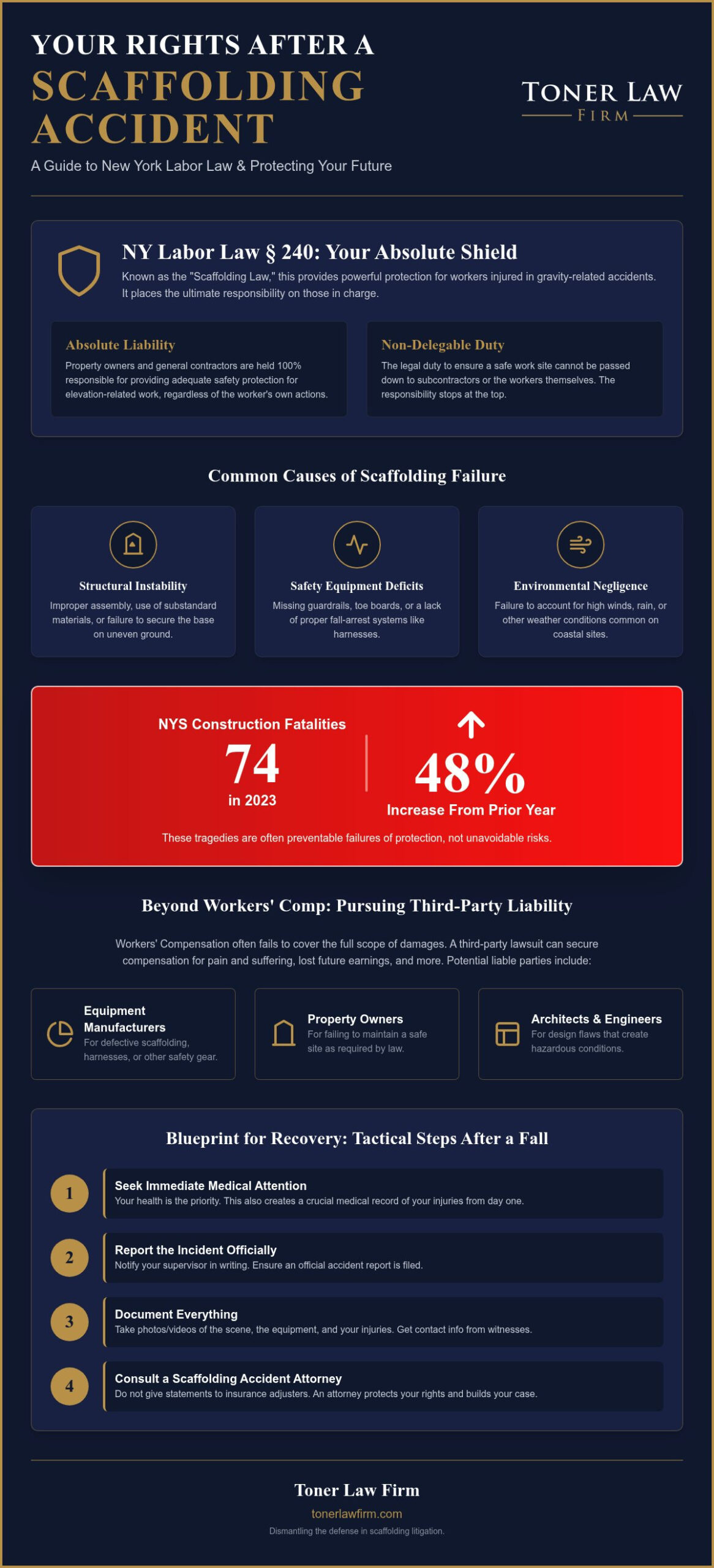
Scaffolding failures are rarely random. They’re the predictable results of cutting corners to meet aggressive deadlines. In our experience, these disasters typically stem from three tactical failures:
- Structural Instability: Hurried assembly using substandard materials or failing to secure the base on the uneven terrain often found on Long Island sites.
- Safety Equipment Deficits: A blatant lack of guardrails, toe boards, or fall-arrest systems like harnesses that are required by law.
- Environmental Negligence: Failing to account for the high winds and unpredictable weather patterns that batter coastal construction sites.
The Long-Term Impact on Your Future
If you think your recovery is just about healing broken bones, then you haven’t calculated the full scope of the damage. A career-ending injury carries a heavy psychological toll and a mounting pile of medical debt that Workers’ Compensation alone cannot cover. In 2023, New York State saw 74 construction-related fatalities, a 48% increase from the prior year. These aren’t just numbers; they represent families destroyed by negligence. Many workers make the tactical mistake of waiting to see if they get better before seeking legal counsel. This delay gives the opposition time to bury evidence and build a defense against your future. We act as your vigilant guardian, ensuring your earning capacity and reputation are protected from the start.
Deconstructing NY Labor Law 240: Your Absolute Shield
If you’ve been injured in a fall, the site owner’s first instinct is often to blame you. They’ll claim you weren’t careful or that you ignored a safety rule to save time. New York Labor Law 240, commonly known as the Scaffolding Law, is designed specifically to dismantle that defense. It creates a “non-delegable duty,” meaning the responsibility for your safety cannot be passed down the chain to someone else. It stops with the property owner and the general contractor. They’re the ones with the authority to enforce safety, and the law holds them to that standard without compromise.
The concept of Absolute Liability is your most powerful tactical advantage in a legal battle. It dictates that if a lack of proper safety equipment leads to a gravity-related injury, the owner and contractor are held responsible regardless of your own actions. Whether it’s a fall from a height or being struck by a falling object, the law assumes that the site’s leadership failed to provide the necessary protection. This shifts the entire burden of safety from the individual worker to those with the power and resources to implement OSHA scaffolding safety standards. Labor Law 240 stands as the primary legal mechanism for worker protection in New York, ensuring that those who profit from construction are held strictly accountable for elevation-related risks. Workers injured in ladder-related incidents on job sites can also benefit from these same absolute liability protections, and consulting a ladder fall injury lawyer NY can help clarify how these statutes apply to your specific circumstances.
Who is Protected Under Section 240?
The scope of this shield is broad, covering workers engaged in construction, demolition, repairing, and painting. It doesn’t matter if you’re a foreman or a day laborer; if you’re performing these tasks at a height, you’re covered. While there are narrow exceptions for owners of one- and two-family dwellings who don’t direct or control the work, most commercial and multi-unit residential projects on Long Island provide no such escape hatch for the opposition. Even subcontractors, who are often treated as disposable by large firms, find full protection under this statute. A scaffolding accident attorney Long Island knows how to verify your status and ensure your rights aren’t bypassed by employer paperwork.
The Owner and General Contractor’s Responsibility
Because the duty is non-delegable, contractors can’t point fingers at smaller outfits to escape liability. This legal structure allows us to target the “deep pockets” in a case—the entities with the substantial insurance policies required to fund your full recovery. We don’t let them hide behind layers of subcontracting agreements or shell companies. By identifying every liable party, a scaffolding accident attorney Long Island can build a case that accounts for the full scope of your medical debt and lost earning capacity. We act as your vigilant guardian, ensuring that those at the top of the project hierarchy pay for the safety failures that happened on their watch.
Beyond Workers’ Compensation: Pursuing Third-Party Liability
If you’re relying solely on Workers’ Compensation, you’re likely leaving the majority of your future recovery on the table. Workers’ Comp is designed to be a quick, “no-fault” fix, but it comes with a heavy price: a low ceiling on benefits. It covers basic medical bills and a fraction of your lost wages, but it ignores the human cost of your injury. It doesn’t account for your pain, your emotional trauma, or the full scope of your career’s lost earning potential. In the high-stakes aftermath of a fall, accepting only these benefits is a tactical retreat you don’t have to make.
The real battle for recovery happens when we look beyond your direct employer to identify third-party liability. This is where a scaffolding accident attorney Long Island changes the trajectory of your case. We deconstruct the project hierarchy to find every entity that failed you. This includes architects who designed unsafe site plans, engineers who overlooked structural flaws, or equipment manufacturers who put defective scaffolding into the stream of commerce. By targeting these third parties, we move the fight into the arena of personal injury litigation, where the potential for financial recovery is significantly higher. Understanding how to strategically pursue third party construction accident claims NY is essential to bypassing the bare-minimum protections of Workers’ Comp and holding every negligent party fully accountable.
One of the most common misconceptions workers have is that being partially at fault prevents them from suing. Under New York’s Absolute Liability standards, this is false. While standard cases use “comparative negligence” to reduce awards, Labor Law 240 focuses on the site owner’s failure to provide adequate protection. If the safety gear was missing or faulty, their responsibility is total. We act as your vigilant guardian, ensuring that your right to a full recovery isn’t undermined by corporate victim-blaming.
Workers’ Comp vs. Personal Injury Litigation
Workers’ Comp is an administrative process, not a pursuit of justice. It offers a predictable, limited payout regardless of who caused the accident. Personal injury litigation, however, allows you to hold negligent parties accountable for the full spectrum of your losses. This includes non-economic damages like emotional distress and loss of enjoyment of life. You don’t have to choose between the two; pursuing both avenues simultaneously is the strategic way to maximize your protection and secure your family’s future.
Dismantling the “Recalcitrant Worker” Defense
Insurance companies are experts at framing the narrative to protect their bottom line. They’ll often deploy the “recalcitrant worker” defense, claiming you simply refused to use provided safety gear. They want to argue that your actions were the “sole proximate cause” of the accident to escape their legal duty. We deconstruct these arguments by proving that the equipment was either insufficient, inaccessible, or that the “safety training” was a mere formality. For broader insights into exposing site-wide negligence, consult a construction accident lawyer Long Island who understands how to expose these corporate maneuvers.
A Blueprint for Recovery: Tactical Steps After a Site Accident
If you’ve just survived a fall, the site owner’s legal team is already moving to insulate themselves from liability. While you’re focused on surgery and rehab, they’re deconstructing the scene to find ways to blame your “carelessness” for the accident. You’re in a high-stakes race against time to preserve the truth before the site hierarchy silences witnesses or “cleans up” the evidence. Establishing a direct medical link between the fall and your injuries is your first priority. Don’t try to “tough it out.” A gap in treatment is a crack in your case that insurance adjusters will exploit to claim your injuries weren’t work-related. Consulting a scaffolding accident attorney Long Island acts as an immediate shield, allowing you to focus on recovery while we secure your legal rights.
Evidence Mechanics: What to Document
Scaffolds are mechanical systems. When they fail, the evidence is in the sheared bolts, the cracked planks, or the missing guardrails. If it’s safe to do so, capture photographic evidence of the entire setup and the surrounding environment immediately. Don’t just photograph the injury; photograph the failure that caused it. You need to prevent the “disappearance” of faulty components that often happens once a site is shut down for investigation. Gather the contact information for independent contractors and other laborers on-site before they move to different projects. These individuals are often the only unbiased witnesses to the safety shortcuts that led to your fall. The same documentation principles apply whether you fell from a scaffold or a ladder; a skilled ladder fall injury lawyer NY relies on this same evidence to build an airtight case for your recovery.
Avoiding Case Sabotage
Insurance adjusters aren’t there to help; they’re there to deconstruct your credibility. If you give a recorded statement without a lawyer present, you’re handing the opposition a weapon they’ll use to twist your words later. Similarly, you should never sign “incident reports” or settlement offers without a thorough legal review. These documents are often drafted to include subtle admissions of fault that can tank a Labor Law 240 claim. Our firm’s experience as a car accident lawyer Long Island has taught us that early intervention is the only way to prevent corporate entities from dictating the narrative of your trauma. We stand between you and the insurance giants, ensuring every tactical move you make strengthens your path to a full financial recovery.
Toner Law Firm: Dismantling the Defense in Scaffolding Litigation
If you’re facing the weight of a catastrophic injury, you need more than a generic legal representative. You need a scaffolding accident attorney Long Island who understands the mechanical failures of a job site and the tactical maneuvers of an insurance company. Toner Law Firm has spent over 30 years deconstructing complex construction cases across Nassau and Suffolk counties. We don’t just aim for quick settlements that leave you underfunded. We prepare every case for the courtroom, exposing the hidden cracks in an adversary’s logic before they can use them against you. This “Vigilant Guardian” approach ensures that we stand as a shield between you and the insurance giants who want to minimize your trauma.
Our local advantage is rooted in decades of navigating the specific court systems of Long Island. We know how the opposition thinks and how they attempt to bury evidence in Nassau high-rise projects or Suffolk residential builds. By treating your case as a high-stakes battle from day one, we maintain a position of hard-earned confidence. We don’t just look at the surface of a claim; we take apart the opponent’s defense piece by piece until their liability is undeniable. You aren’t just another file in our office. You’re a worker whose future depends on our ability to outmaneuver powerful institutions.
Our Advocacy-Driven Process
When you partner with our firm, you receive personalized attention from James Toner himself, not a junior case manager. We bring a real-world grit to every case because we understand the physical reality of construction work and the devastating impact of a fall. Our process is designed to uncover the hidden vulnerabilities in the opposition’s strategy. We deconstruct the site hierarchy and the mechanical details of the scaffolding to find where safety was sacrificed for profit. This level of tactical scrutiny is what a scaffolding accident attorney Long Island must provide to secure a full financial recovery for an injured individual.
Taking the First Step Toward Justice
Time is a tactical asset that you cannot afford to waste. In New York, the statute of limitations for personal injury is typically three years, but claims against municipal entities have much tighter windows, often requiring a Notice of Claim within 90 days of the accident. Taking immediate action is a necessity to preserve evidence and secure witness testimony before it’s lost. We operate on a “No Recovery, No Fee” basis, which levels the playing field against wealthy corporations. You don’t pay us unless we win. Contact Toner Law Firm today for a tactical case evaluation. We are ready to stand by your side and fight for the reputation and future you’ve worked so hard to build.
Reclaiming Your Future After a Site Fall
If you’re still feeling the weight of a life-altering fall, remember that the law was written to protect you, not the corporations that cut corners to meet a deadline. You’ve learned that New York Labor Law 240 provides an absolute shield by holding owners and contractors strictly liable for gravity-related risks. You also know that identifying third-party liability is the only tactical way to bypass the restrictive ceilings of Workers’ Compensation and secure full financial recovery for your pain, suffering, and lost earning capacity. This isn’t just about a paycheck; it’s about restoring the stability they took from you.
The opposition will continue to deconstruct your claim to find a way out, but they aren’t prepared for a defense that has been trial-tested for over 30 years. By choosing a seasoned scaffolding accident attorney Long Island, you’re placing a vigilant guardian between yourself and the insurance giants who want to silence your story. We understand the nuances of the Nassau and Suffolk court systems and we know how to expose the hidden flaws in their legal strategy. You’ve worked hard to build your reputation; don’t let a single failure of safety tear it down. Secure your future with a tactical scaffolding accident attorney; contact Toner Law Firm. Your recovery is our battlefield, and we are ready to stand with you.
Frequently Asked Questions
What is the “Scaffolding Law” in New York?
New York Labor Law 240, commonly known as the Scaffolding Law, is a protective statute that imposes absolute liability on property owners and general contractors for elevation-related injuries. It mandates that these powerful entities provide adequate safety devices, such as harnesses and guardrails, for workers performing tasks at heights. If they fail in this duty and a fall occurs, they’re held responsible for the resulting trauma regardless of any subcontracting agreements they might’ve signed.
Can I sue for a scaffolding accident if I am also receiving Workers’ Compensation?
You can absolutely pursue a personal injury lawsuit against third parties while simultaneously receiving Workers’ Compensation benefits. While your employer is generally shielded from direct lawsuits, Labor Law 240 allows you to target the property owner or general contractor who failed to secure the site. This dual-track approach is a vital tactical move to secure the full financial recovery that Workers’ Comp alone cannot provide for your pain and suffering.
How long do I have to file a scaffolding accident claim on Long Island?
Personal injury claims in New York typically carry a three-year statute of limitations from the date of the accident. However, if your fall occurred on a site owned by a municipal or public entity on Long Island, you must file a Notice of Claim within 90 days. Missing these deadlines is a fatal tactical error that permanently bars you from recovery. Contacting a scaffolding accident attorney Long Island immediately ensures your rights are shielded from these strict timelines.
What happens if I was partially responsible for my own fall from a scaffold?
Your partial fault doesn’t automatically disqualify you from recovery under Labor Law 240. Because the law imposes absolute liability, the owner and contractor are responsible if they failed to provide proper safety devices that could’ve prevented the fall. Unless your actions were the “sole proximate cause” of the injury, their negligence in site safety remains the primary legal focus. We specialize in deconstructing these corporate blame-shifting tactics to protect your future.
Who is legally responsible for providing safety equipment on a construction site?
Property owners and general contractors bear the non-delegable duty to provide and maintain all necessary safety equipment on a New York construction site. This responsibility cannot be shifted to subcontractors or individual laborers. Whether the site is a Nassau high-rise or a Suffolk residential expansion, these lead entities must ensure that scaffolds, ladders, and harnesses meet strict safety standards. If they neglect this mechanical duty, they’re legally accountable for the consequences.
Can an undocumented worker file a scaffolding accident lawsuit in New York?
Undocumented workers have the same right to file a personal injury lawsuit under New York Labor Law as any other laborer. Your immigration status doesn’t shield a negligent site owner from their responsibility to provide a safe working environment. We act as a vigilant guardian for all workers, ensuring that powerful entities cannot use your status as a weapon to intimidate you or avoid paying the compensation you’ve earned through your labor.
What kind of compensation can I recover in a scaffolding accident case?
You can recover damages that far exceed the limited scope of Workers’ Compensation. A successful lawsuit allows you to claim compensation for all medical bills, the full value of your lost earning capacity, and significant awards for pain and suffering. We also pursue damages for emotional distress and loss of enjoyment of life. Partnering with a scaffolding accident attorney Long Island ensures that every hidden cost of your injury is identified and calculated for your recovery.
What should I do if my employer threatens me after I report a scaffolding fall?
Reporting a workplace injury is a protected right, and employer retaliation is illegal under New York law. If you face threats of termination or blacklisting after a fall, you must seek legal counsel immediately to document these actions. We stand firmly on the side of the individual, acting as a shield against intimidation tactics. Don’t let fear dictate your recovery; instead, use the law to hold them accountable for both the accident and their misconduct.