


The empty space where a reckless driver should be standing isn’t a dead end for your recovery; it’s a tactical hurdle that requires a seasoned defender to clear. If you’ve been left on the side of a Nassau County road with mounting bills and no one to point a finger at, you likely feel abandoned by a system that seems to favor the anonymous. Securing a hit and run attorney Long Island families rely on means moving past the initial shock and into a calculated strategic offensive. You aren’t just fighting a ghost; you’re deconstructing a complex web of insurance mechanics designed to protect the bottom line of massive corporations at your expense.
It’s exhausting to stare at a No-Fault application while wondering how you’ll pay for surgery when the offender vanished into the night. This guide will show you exactly how to secure compensation and hold shadow defendants accountable, even if the police never find the vehicle. You’ll discover the strict 2026 MVAIC filing deadlines, the hidden power of your own Uninsured Motorist coverage, and the precise legal maneuvers used to force insurers to honor their obligations. Your path to recovery doesn’t stop because a driver fled; it starts by using the law as your shield and your sword.
Key Takeaways
- Learn why New York VTL § 600 treats leaving the scene with extreme gravity and how this impacts your civil recovery in Nassau and Suffolk courts.
- Discover how to secure payment for medical bills using MVAIC and UM coverage, effectively holding insurance companies accountable even when the driver is missing.
- Follow a tactical blueprint for the “Golden Hour” of evidence to ensure critical witness statements and police reports aren’t lost to time.
- Understand why hiring a hit and run attorney Long Island relies on provides a unique advantage by bridging the gap between criminal evidence and civil liability.
- Navigate the rigid 2026 reporting deadlines to protect your right to compensation and shield your future from the financial impact of a hit and run.
Understanding Hit and Run Laws on Long Island: The Legal Stakes
If you’ve been left on the pavement while a taillight disappears into the distance, you’re facing a legal battle that is both criminal and civil in nature. Under New York Vehicle and Traffic Law (VTL) § 600, leaving the scene of an incident is a direct violation that triggers immediate consequences. For property damage, it’s an infraction; for physical injury, it quickly escalates to a misdemeanor or felony. In Nassau and Suffolk Counties, where traffic fatalities reached at least 163 in 2025, the courts have zero patience for those who flee. This is why a hit and run attorney Long Island residents trust must act fast to preserve evidence before the trail goes cold.
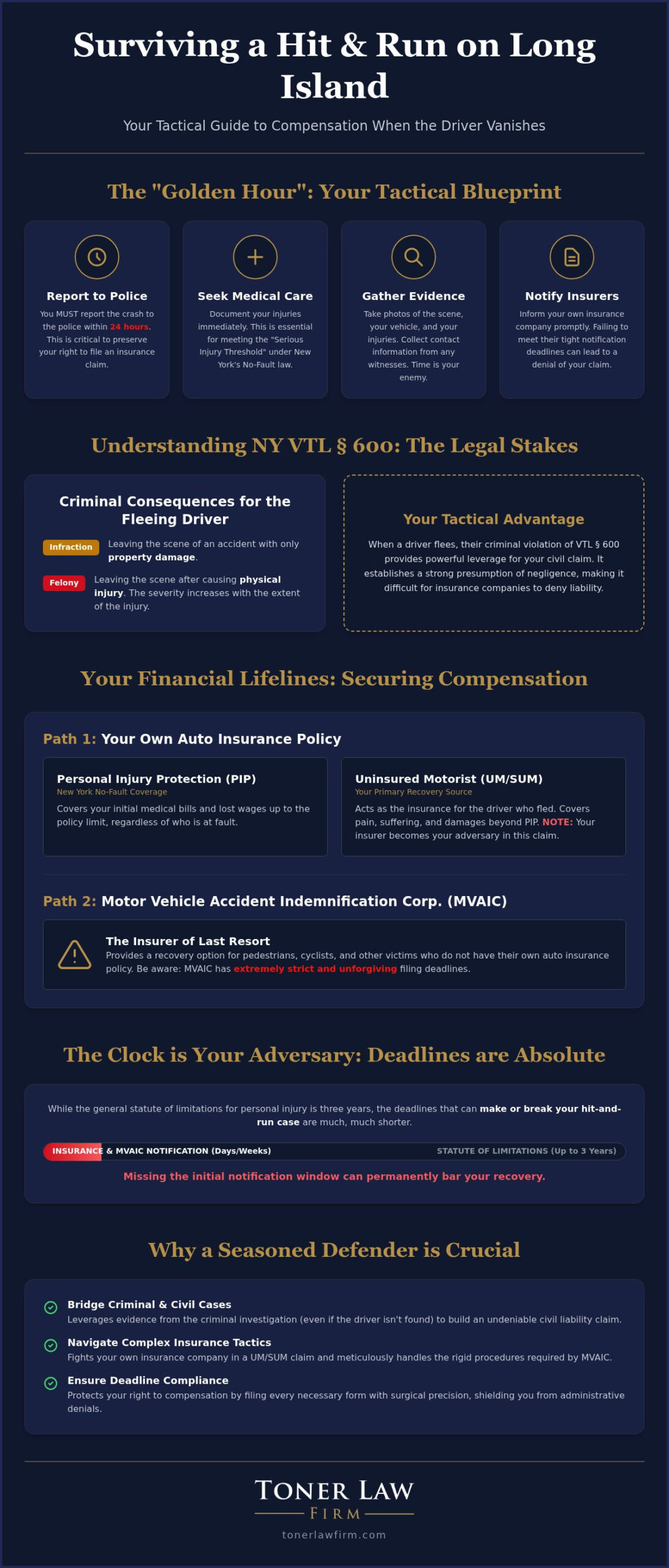
The first 24 hours are the “Golden Hour” of your legal future. If you fail to report the crash to the police within this window, you risk losing access to the Motor Vehicle Accident Indemnification Corporation (MVAIC) and your own Uninsured Motorist (UM) benefits. Understanding Hit and Run Laws and their local application is vital because the law doesn’t just punish the offender; it provides the mechanics for your survival. It is a brutal reality. You are fighting a ghost, and the clock is your primary adversary.
VTL § 600: Criminal vs. Civil Implications
When a driver flees, they hand you a tactical advantage in a civil courtroom. A criminal conviction or even a police report citing a VTL § 600 violation serves as a cornerstone for your claim. It’s difficult for an insurance company to argue their driver wasn’t negligent when that driver is facing a Class E felony for causing serious injury. We deconstruct these cases by leveraging every scrap of evidence from the criminal investigation to fuel your civil recovery. It’s an “us versus them” dynamic where their criminal flight becomes the catalyst for your financial justice.
The ‘No-Fault’ Reality for Hit and Run Victims
New York’s No-Fault system is designed to provide immediate relief, but it often feels like a trap. Your own insurance is responsible for medical bills through Personal Injury Protection (PIP), yet they’ll fight you every step of the way. To move beyond basic medical bills and seek compensation for pain and suffering, you must cross the “Serious Injury Threshold.” If you don’t have your own auto insurance, MVAIC acts as the insurer of last resort, but their filing deadlines are unforgiving. A hit and run attorney Long Island expert knows how to navigate these insurance hurdles so you aren’t left paying for someone else’s cowardice. Don’t let them win.
How to Secure Compensation When the Other Driver is Missing
If the driver who hit you has vanished, you aren’t just looking for a person; you’re looking for a policy. A missing defendant is a tactical hurdle, not a dead end. To secure your future, we pivot from chasing a ghost to deconstructing the insurance mechanics that already exist to protect you. This process requires a hit and run attorney Long Island residents rely on to navigate a system that is intentionally rigid and often hostile to victims. You aren’t alone, but you must be strategic.
Timing is your greatest enemy in these cases. While the standard statute of limitations for personal injury in New York is three years, the windows for insurance notification are significantly smaller. If you wait too long to notify your own carrier or fail to follow official DMV procedures regarding crash reporting, you give the insurance company a “get out of jail free” card. They’ll use any administrative slip-up to deny your claim and protect their profits. We act as your shield, ensuring every form is filed with surgical precision.
Uninsured Motorist (UM) and SUM Coverage Mechanics
Uninsured Motorist (UM) coverage is your primary recovery source in hit and runs, essentially stepping into the shoes of the driver who fled. While standard UM covers basic losses, Supplemental Uninsured/Underinsured Motorist (SUM) coverage provides a much larger recovery pool, often matching your own liability limits. The conflict here is internal. Your own insurance company becomes your adversary in a UM claim, as they now have a financial incentive to prove you were at fault or that your injuries aren’t “serious” under New York law. Dealing with your own carrier requires the same level of defiance you’d use against a hostile stranger.
MVAIC: The Last Resort for Long Island Pedestrians and Cyclists
The Motor Vehicle Accident Indemnification Corporation (MVAIC) is a non-profit safety net for victims who have no other auto insurance available to them. This typically applies to pedestrians or cyclists who don’t own a car and don’t live with a relative who does. MVAIC is notoriously difficult to satisfy. To qualify, you must report the accident to the police within 24 hours and file a “Notice of Intention to Make Claim” within 90 days for unidentified vehicles. In 2020, MVAIC paid out on fewer than 3% of the notices they received, proving that without a hit and run attorney Long Island victims trust, the “last resort” often remains out of reach. If you are struggling to navigate these hurdles, a car accident representation specialist can help you force the system to work in your favor.
If the Nassau or Suffolk County police successfully track down the driver who fled, the nature of your case shifts from a defensive insurance claim to an aggressive pursuit of liability. A hit and run attorney Long Island families trust knows that a criminal arrest isn’t just about jail time; it’s a strategic asset for your civil lawsuit. We don’t just wait for the District Attorney to act. We actively harvest the police reports, body cam footage, and witness statements generated by the criminal investigation to dismantle the driver’s ability to lie during a deposition. When the state proves they fled, the “us versus them” dynamic tilts heavily in your favor.
Deconstructing the Hit and Run Defense
Drivers who flee usually rely on a predictable script of excuses. You’ll often hear claims like “I didn’t know I hit anyone” or “I thought I hit a piece of road debris.” These defenses rarely survive the forensic scrutiny of a seasoned advocate. We leverage traffic camera data from the Long Island Expressway (LIE) or the Northern State Parkway to prove the driver was aware of the impact. If the defendant enters a guilty plea to a VTL § 600 violation, it acts as a definitive admission of fault. In the eyes of a civil court, that plea effectively ends the debate over liability. It leaves the insurance company with no choice but to negotiate.
Punitive Damages: Sending a Message to Fleeing Drivers
Standard personal injury claims focus on compensatory damages, which are designed to cover medical bills and lost wages. However, hit and run cases are primary candidates for punitive damages under New York law. These are specifically designed to punish conduct that is exceptionally reckless or shows a “wanton” disregard for human life. Because leaving an injured person on the road is often viewed as gross negligence, courts allow these awards to serve as a deterrent. These damages can significantly increase your total recovery by adding a financial penalty for the driver’s cowardice.
Insurance companies are terrified of punitive damage claims. They know that a Long Island jury will have zero sympathy for a driver who left a neighbor bleeding on the side of the road. When we present a criminal conviction alongside a demand for punitive damages, we create massive exposure for the insurer. This pressure often forces them to the settlement table far faster than a standard car accident claim. We use the driver’s criminal flight as a mechanical lever to pry open the insurance company’s coffers and secure the justice your recovery requires. If you are also pursuing a car accident settlement Garden City residents depend on, understanding how punitive damages interact with your overall compensation strategy is essential to maximizing your recovery.
Immediate Steps: Your Long Island Hit and Run Tactical Blueprint
If you’re standing on the shoulder of Sunrise Highway while the perpetrator speeds away, your adrenaline is lying to you. You might feel “fine” or think the damage is minor, but this is the exact moment when insurance companies begin building their case against you. To secure your recovery, you must transition from a victim to a tactical collector of facts. The “Golden Hour” of evidence is a narrow window where the physical proof of the crash is still fresh and witnesses haven’t yet disappeared into the Nassau or Suffolk traffic. A hit and run attorney Long Island residents rely on will tell you that what you do in these first sixty minutes dictates the strength of your future claim.
Evidence Collection on the Scene
Don’t wait for the authorities to arrive to begin deconstructing the scene. Your phone is your most powerful tool for capturing the mechanical reality of the impact. Focus on these critical elements:
- Identify Witnesses: Approach anyone who stopped. Secure their names and phone numbers immediately. Their independent accounts are the only way to dismantle a “phantom vehicle” denial from your insurer.
- Document the Environment: Photograph paint transfers on your car, skid marks, and any debris left by the fleeing vehicle. These are forensic fingerprints.
- Locate Cameras: Look for doorbell cameras or commercial surveillance at nearby intersections. In 2026, many Long Island corridors are heavily monitored, but this footage is often overwritten within days.
- Pinpoint Location: Note exact cross-streets or mile markers. A report that says “near Garden City” is far less effective than one that cites the specific exit on the Meadowbrook Parkway.
Local Reporting Procedures: Nassau and Suffolk
You must report the incident to the Nassau County Police Department (NCPD) or the Suffolk County Police Department (SCPD) within 24 hours. This isn’t just a suggestion; it’s a legal requirement for MVAIC and UM coverage eligibility. When the officer arrives, ensure the report explicitly states it was a “Hit and Run” or “Leaving the Scene.” If you’re within a village like Garden City, you’ll need to obtain the report from the local precinct’s records bureau. This document is the foundation of your case. Without it, you’re effectively invisible to the legal system.
Once the reporting is done, go to the emergency room. Internal injuries often mask themselves behind a wall of shock. If you wait three days to see a doctor, the insurance adjuster will argue that your injuries didn’t happen at the crash site. They’re looking for any gap in your medical history to use as a weapon. Never speak to an adjuster before you’ve secured a seasoned defender. They aren’t there to help you; they’re there to minimize their financial exposure. If you’ve been abandoned on the road, contact a hit and run attorney Long Island specialist to act as your shield and start the fight for the compensation you deserve.
Why You Need a Seasoned Defender for Your Long Island Claim
If you’re fighting an insurance giant after a hit and run, you aren’t just up against a company; you’re up against an algorithm designed to minimize your suffering. Insurance adjusters are trained to find the smallest cracks in your testimony or the tiniest delay in your medical treatment to justify a denial. This is where the “us versus them” dynamic becomes a reality. Securing a hit and run attorney Long Island families trust means hiring a shield that stands between you and the predatory tactics of multi-billion-dollar corporations. We don’t just “handle” your file; we deconstruct the opposition’s strategy until their logic fails.
Our firm brings a unique advantage to the table by operating at the intersection of criminal defense and personal injury litigation. We understand the mindset of a fleeing driver because we know the legal system from the inside out. This dual perspective allows us to anticipate the defense’s moves before they even make them. You aren’t just a claim number to us. You’re a neighbor whose life has been upended by a coward’s choice, and we treat your recovery with the gravity it deserves. With our “No Recovery, No Fee” promise, we take on all the financial risk of your litigation. If we don’t win, you don’t owe us a dime for our services.
James Toner: 30+ Years of High-Stakes Advocacy
James Toner has spent over three decades in the thick of high-stakes legal battles, developing a “Battlefield” approach to litigation. We don’t wait for the insurance company to offer a fair settlement; we force them to the table by exposing the flaws in their denials. Our Garden City location provides a distinct home-field advantage in Nassau and Suffolk courts. We have deep roots in the local legal community, and we know how Long Island juries react to hit and run cases. This seasoned expertise is the difference between a minimal payout and a recovery that actually secures your financial future.
Taking the First Step Toward Recovery
Your path to justice begins with a single tactical evaluation. When you sit down for your free, confidential consultation, we’ll take apart the facts of your accident and identify the most viable path to compensation. To make this first meeting as productive as possible, please bring the following items:
- A copy of the police report from the NCPD, SCPD, or local precinct.
- Any medical records or discharge papers from your initial treatment.
- Photos of your vehicle damage and the accident scene.
- Correspondence you’ve received from your own insurance carrier.
Don’t let a fleeing driver have the final word on your future. We are ready to act as your vigilant guardian and fight for every dollar the law allows. Contact Toner Law Firm today for a tactical evaluation of your case.
Take Back Control of Your Legal Future
If you’ve been left behind by a fleeing driver, the path forward requires more than just hope; it requires a calculated offensive. You now understand that a missing defendant isn’t a barrier to your recovery if you leverage the right insurance mechanics and adhere to strict 2026 reporting deadlines. From deconstructing the “Golden Hour” of evidence to forcing insurers to honor UM and MVAIC obligations, you have the tactical blueprint needed to fight back. You don’t have to navigate this hostile system alone while the medical bills continue to mount.
Securing a hit and run attorney Long Island victims trust is about finding a shield against the institutional indifference of insurance companies. With over 30 years of trial experience and deep roots in Garden City, we provide the high-stakes advocacy necessary to secure justice in Nassau and Suffolk courts. We’ve spent decades dismantling the defenses of reckless drivers and the corporations that protect them. Your recovery is our mission, and we won’t stop until the shadow defendant is held accountable through the law. Secure Your Recovery: Schedule a Free Hit and Run Case Evaluation today and move from a place of vulnerability to a position of strength.
Frequently Asked Questions
Can I still get a settlement if the driver who hit me is never found?
Yes, you can still secure a settlement by pivoting your claim toward your own Uninsured Motorist (UM) coverage or the Motor Vehicle Accident Indemnification Corporation (MVAIC). A missing driver doesn’t erase your right to recovery; it simply changes the source of the funds. We treat the insurance company as the adversary, deconstructing their attempts to deny your claim based on the driver’s absence. You aren’t fighting a person; you’re fighting for policy benefits.
What is the deadline to file a hit and run claim on Long Island?
You must report the accident to the police within 24 hours to remain eligible for most hit and run benefits. While the New York civil statute of limitations is generally three years, MVAIC requires a “Notice of Intention to Make Claim” within 90 days for unidentified vehicles. Missing these tactical windows can sabotage your entire case. A hit and run attorney Long Island families rely on will ensure every administrative deadline is met with surgical precision.
Will my insurance rates go up if I file an Uninsured Motorist claim?
New York law generally prohibits insurance companies from increasing your premiums for filing a claim where you weren’t at fault. If a reckless driver flees the scene, they are the negligent party, not you. Don’t let the fear of a rate hike prevent you from accessing the coverage you’ve funded. We act as a shield against insurers who try to intimidate victims into leaving money on the table through subtle threats of future costs.
What happens if I was a pedestrian in a hit and run accident?
Pedestrians are protected under their own household auto insurance policies even if they weren’t driving at the time of the impact. If you don’t own a vehicle and don’t live with someone who does, MVAIC serves as your safety net. This system provides up to $50,000 in No-Fault benefits and $25,000 for bodily injury. Navigating these mechanics requires a seasoned defender who understands the nuances of Long Island’s specific pedestrian safety laws and insurance requirements.
Do I need a lawyer if the police are already investigating the hit and run?
Yes, because the police are focused on criminal prosecution, not your financial restoration. While an NCPD or SCPD investigation provides critical evidence, it doesn’t automatically pay your medical bills or replace your lost wages. You need an advocate who can leverage that criminal evidence to dismantle insurance denials in civil court. We bridge the gap between the police report and your actual recovery, ensuring your future isn’t a casualty of the investigation.
What if the driver who hit me didn’t have insurance?
If the driver is identified but lacks coverage, your Uninsured Motorist (UM) policy steps in to provide the necessary recovery pool. This is a mechanical substitution where your insurer takes the place of the defendant’s missing policy. It’s a high-stakes conflict because your own carrier will now look for flaws in your case to save themselves money. We deconstruct their arguments to ensure you receive the full value of your Supplemental Uninsured Motorist coverage.
How long does a hit and run lawsuit typically take on Long Island?
The timeline for a Long Island hit and run claim varies based on the complexity of the evidence and the severity of your injuries. While some insurance settlements are reached within months, complex litigation involving “phantom vehicles” or serious injuries can take over a year. We push for an escalating pace to prevent the opposition from stalling. Our goal is to move you from vulnerability to empowerment as efficiently as the legal system allows.
What is MVAIC and how do I know if I qualify for it?
MVAIC is a non-profit corporation designed as the “insurer of last resort” for New York residents hit by unidentified or uninsured vehicles. You qualify if you have no other auto insurance available and weren’t the owner of the uninsured vehicle involved. It’s a rigid system with unforgiving deadlines, such as the 24-hour police reporting rule. Consulting a hit and run attorney Long Island expert is vital to ensure you don’t accidentally forfeit these essential benefits.